
Shut-In Training Program: Issue #2

Issue #2: Supplements!

The Asheville Running Collective is here for a second edition of the Shut-In Training Program newsletter to provide you with a proverbial medicine cabinet chock full of powerful supplements to boost your training. If you missed the the rollout of the program, you can check it out on our website where we will archive all of these posts.

OK, here’s the plan: take a teaspoon of ACV (apple cider vinegar, duh!), with a 1/2 gallon of EVOO (healthy fats!), 2 packets of expired GUs that have been heating up in your car all summer (save the safer room temp ones for race day), a handful of that green probiotic powder you bought on the recommendation of a podcaster, and a smashed up assortment of whatever you can find in those half-empty bottles of Runner’s Daily Multivitamins stuffed in the back of your closet. Now, fire up your Magic Bullet and…

Of course, that was a joke, and a gross one to boot. In reality, we’ve got a healthy serving of training ideas, strength exercises (from an actual expert!), and interesting resources to supplement the plan you’ve already got in place. Let’s dive in.


Work on Your Weaknesses (Now)

With a bit less than two months until race day, it’s a great time to assess your skills and abilities as they relate to the specific demands of the Shut-In race course. How’s your efficiency when climbing? Are you quick and nimble down the backside of Ferrin Knob or are your heels digging holes in the trail as you grab for the nearest tree at every switchback? What gives out first: your lungs or your legs?

As mentioned in the first edition of this training program, this is an aerobic event. High-end sprint speed is certainly helpful to grab prime camera time up front in the first 100m, but as you are crossing 151 with a couple miles and several hundred feet of gain still to come, you’ll probably be drawing on the strength of the long runs you’ve put in over the course of your training block (or cursing the ones you missed). So, aerobic conditioning, base building, endurance work, or whatever you want to call lots of time spent on your feet still needs to be the priority.

Beyond that, you should consider how to fill in the gaps in your fitness and/or skills. These supplementary sessions should be moderate efforts that don’t require you to significantly alter the rest of your week’s plan. Think of it like “skill building” rather than “fitness building”.

Here are a few different categories and session ideas, based on generalized runner types:

Runner A: I can go up all day, but I fall behind on the flats and downs.
Consider adding in supplementary workouts to improve efficiency and turnover. Short, fast sessions at the track, short hills at a quick effort, and pace-changing workouts on the trail could go a long way in this regard. Some ideas:

  • Strides: There’s really no bad time to throw in 4-6 x 20-sec quick (40-sec jog). Mix it up with some pick-ups in the middle of a run OR finish off a trail run with some quick & smooth parking lot bursts.

  • Hills + 200s: 4-6 x 40-sec hill reps at quick (but controlled) effort + 4-6 x 200m at the same effort (of course you can just do 40-sec on any flat terrain if you don’t have access to a track).

  • Up and Overs: Add a flat or downhill portion to your previously planned hill reps. Practice keeping your rhythm as you crest the hill and seamlessly transitioning to 10-20 seconds of additional running on a subsequent flat or downhill stretch.

  • “True” Fartlek: Over the course of 20-30 minutes, throw in pickups of 30-seconds to 2 minutes with easy running between. Don’t overthink it. Don’t try to structure the perfect session. Just run from this tree to that tree pretty quick, jog for a bit, and repeat a bunch of times.

Runner B: My legs give out before my lungs.
You may need to improve your race specific muscular endurance. This can happen in the weight room, but it’s getting late in the game to try too many new non-running routines. Instead, focus on the demands of the course that pose the biggest challenge for you. One guess: hills.

  • Steep Power Hiking: Find the steepest hill you can and power hike up several times. Keep volume moderate to begin, so try 4 x 5:00 the first time, and build over 2-3 subsequent sessions.

  • Long Uphill Grind: Find a the steepest grade that you can run and lock into your efficient climbing gear for 10-20 minutes. The treadmill works for this, too.

  • “Hit the Hills” Fartlek: Run this like the “true” fartlek above, but all pickups occur on the uphills. Flats and downs are run nice and easy.

Runner C: I move well on the flats, ups, and downs, but I run out of steam as the time goes on.
You need to focus on building your aerobic engine. Keep maintenance workouts in for climbing, efficiency, etc, but add in another endurance-focused session.

  • Medium Long Run: this can be somewhere in the zone of 75% of the duration of your current long run. Keep the effort easy.

  • Steady Run: Elevate your “easy run” pace slightly. Use the “talk test” to go from chatting in full paragraphs to speaking in one or two sentences at a time. You are still in control and should be able to hold this effort for a long time. Start with 30 minutes in the middle of a run and build toward 60 minutes over the course of the cycle. This effort could be considered “aerobic threshold”, the top of zone 2 on a 5-zone HR model, or “steady state” depending on who you ask.

As a reminder, these sessions should all supplement the major workouts and long runs you are all planning. Beware of the temptation to turn everything into a “fitness building” workout. If you push these too hard, you run the risk of compromising a higher priority training day later in the week.

- Mark


Make #Gains

Many of us in the WNC running community know Miriam Salloum as one of the three emergency contacts in our phones. Thankfully, she hasn’t figured out how to block our calls, and she actually keeps her cool when we text asking for an appointment in the next 20 minutes.

Miriam is the the talented physical therapist behind The Runners Mechanic located in downtown Asheville. Below you will find a series of exercises well suited to athletes taking on the demanding ups and downs of Shut-In. Use these as activation work prior to a run OR as part of a separate strength session.

Check out the whole playlist of Miriam’s videos here:
The Best Strength Exercises for Power and Symmetry with Running


In Their Own Words

One of the goals of this Shut-In project is to document the history of the event. Along with race stats, course changes, and interesting results, we plan to share race recollections and advice from a variety of runners.

This week, Javan Lapp got on the phone with 34-time Shut-In Ridge Race finisher Chris Campbell to talk about his long relationship with this special section of trail. Chris has a best finish of second place from the 1990 edition of the event.

This interview was edited for length and clarity.

Javan Lapp: Are there any secrets to your longevity or anything you’d attribute to your success over such a long time period?

Chris Campbell: Well, mostly dumb luck, I guess.

When I turned 40, I was going to try to run some races and try to set some masters course records. I immediately got injured. That didn't work out so well! It took a year or so to figure out what I could do as I got older. I think I've just done a pretty good job since then to monitor when I'm doing too much or when something doesn't feel right. I learned to back off, whereas my younger self would have just said “you can run through that”. And, as you will see, at some point, usually you can't.

JL: I'm already learning that lesson.

CC: Definitely. I’ve actually gone through the whole spectrum of finishes. From being top-20 a bunch of times to 2019 when I turned my ankle in training and really didn’t know if I would be able to make the cut offs. That ended up being my slowest year, but in a lot of ways it was really satisfying. Knowing the course helped me a lot that year, and knowing that I just had to plug away at it and not do too much too early.

JL: What are the differences in the experience of racing toward the front versus the middle or the back of the pack?

CC: They're really different. Most years now, I just try to get out and enjoy the trail. Certainly, you know, I want to run it as fast as I can on that day, but not at the expense of making myself miserable. My days of being out front are done, so I might as well get out there and enjoy the heck out of it.

I've had a couple of years in the last ten or so where I just kind of hooked up with somebody who was either a first time racer or a less experienced Shut-In runner. I’ve gotten into some conversations and gotten to know people in the middle of the pack, which was kind of cool.

1991...First time Shut-In is shortened due to snow.

JL: Any guiding advice for new Shut-In racers?

CC: The first thing I would tell them is basically treat it like training for a marathon. However, focus more on time than distance. When doing a road marathon most people work the long run up to 20 or 22 miles. Use the time it would take to run that far on the road to plan what you want your longest run to be on the trails.

Also, I've noticed that a lot of the mid pack runners or those from an ultra background walk many of the hills from the outset. You can't do that at Shut-In if you're going to make the cut off times. So somebody who's coming from an ultra background or someone trying to make the cut offs, they definitely need to have more of a mindset that they've got to run up hills that are not super steep.

JL: Has Shut-In always been the main trail race you’ve focused on?

It just became my fall marathon. I never really set out to to run it as much as I have. But I just haven't found a good reason not to run it.
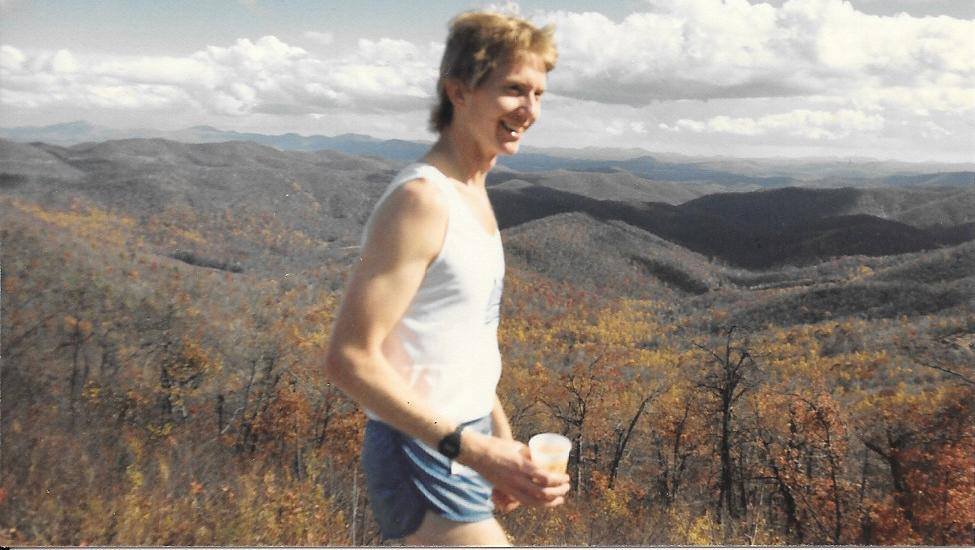
Chris in 1988

Thanks to Chris for sharing his wisdom, as well as these great photos!


Up Next

The details of Phase 2 and the Taper Phase will be introduced and explained in the coming weeks.

Future missives will also cover:
- Suggestions for planning your training volume
- More workout ideas!
- Tips, tricks, and race recollections from experienced Shut-In racers

What would you like to read more about? Send us your questions, comments, or ideas with “SHUT IN” as the subject line.
Shut-In Training Program: Introduction & Phase 1

An Introduction

The Asheville Running Collective is excited to have you along for the journey as we move through our ten-week training program.

The overall plan is divided up into three distinct phases with workouts assigned in two-week blocks. Through semimonthly emails, the current phase’s workout details, explanations, and examples will be shared alongside training tips, strength work, and more.

Considerations

The ARC’s 10-week training outline is focused on providing general ideas (with specific examples) to aid you in structuring your own training. It would be irrational (and irresponsible) to propose one specific plan as the golden ticket to Shut-In glory. An athlete’s unique set of strengths and weaknesses (AKA: “areas for growth!”), training and racing experience, and life circumstances should inform the kinds of workouts performed and the time at which they are implemented. Hopefully, the training ideas and examples that follow will provide you with new information, motivation, and/or just some food for thought.

+ Personal preferences can lead to a bias toward (or away from) one kind of workout, nutrition plan, or race strategy. These may be grounded in the successful execution of a goal race (“Wow, those hill reps really made me feel strong!”), the recurring nightmares of an epic blow-up (“Note to self: stop mixing Maurten with mayo”), or the current topic trending on your social media feed (“If double threshold days work for Henrik, Filip, and Jakob, surely they’ll work for me!”). Some of these ideas may be valid and should be considered when figuring out where to place an emphasis in your training cycle. Others may be the extra 1% that you really shouldn’t worry about until you’ve got the first 99% figured out. A major part of the deal with planning and executing a successful training plan, as well as nailing the subsequent goal race, is figuring out these details, knowing when to push further, and recognizing when to cut back. You’ll be the best judge when it comes to this part of the plan. If not, hire a coach to do it for you!

+ Life circumstances will also play a large role in the way an athlete can prepare for the specific demands of any event. Shut-In goes uphill. Actually, it starts with a downhill, but before ya know it… right back up. After a couple of dips, it goes back up a bunch more. It’s flat for a while, but then right back up. To be honest, it finishes on a downhill, too. Some people forget that. However, there’s a pretty nasty climb right before, so… basically, it’s hilly. You may not have hills to train on (shout out to our beach-based subscribers!), so some/many of the workouts suggested here won’t directly apply. However, they can still serve as a reminder that the race definitely has a lot of uphill and you should figure out some workarounds to prepare for that.

+ In the same vein, you might not be local, so you’ll be scratching your head at the mention of Kitsuma, Chumbawamba, and some of the other cherished routes that may be mentioned in workout examples. No worries. You can get the general spirit of the workout and apply it at your preferred training ground.


Threading the Needle

No one-size-fits-all plan can actually fit the needs of everyone. This outline is crafted with the idea of being doable by a good number of people, with some amount of the audience needing to scale it back, and another group ready to add on. All runners should plan to supplement the workouts given with the training they need to stay healthy, build fitness, and be ready on race day. Some ideas for regressions, progressions, and supplementations will be given along the way.

+ Volume is another tricky area to plan for when sharing a training program with a large audience. You should be realistic about your starting point, the time you can commit to training, and the demands of the event. At the same time, this is an aerobic event and it would be considered a “long distance” by most (no comments from the 200-mile specialists in the crowd, please). So, you definitely need to put in some volume (relative to your experience and ability), and build your endurance.

+ The training outline is made for an athlete that has put in a period of training and has built up a decent base of fitness prior to beginning the ten weeks. If you are lacking a base, your Shut-In prep should prioritize easy and steady running while building up your long run.


The Nuts and Bolts

The plan is laid out into two major four-week training phases followed by a two-week taper period. Each training period is broken into two-week blocks. This will give you some flexibility when planning your workouts.

To start the program, we will focus on Phase 1. General workouts are listed below with workout details and examples coming soon in a future email.

Training Phase 1: Build Fitness
Key Points:
-
Build up training volume
- Lengthen the Long Run
- Incorporate a variety of efforts
- Improve efficiency with strides and hill workouts
- Work on weaknesses

Notes:
- Focus on effort over pace early in the training block.
- Use effort-based guides if you don’t have much recent experience with shorter distance races (ex: “quick” for 5k race pace/effort and “strong” for 10k race pace/effort).
- This training outline does not include “hero” workouts. Save the race effort for race day (or include 1-2 tune-up races or time trials to feed your need for speed).
- Aim to get in these four workouts over the two-week period. Fill in the week with easy running, supplementary workouts (more info to come on those), cross training, and/or recovery days as needed.

Phase 1 Outline
Weeks 1 & 2: August 29 - September 11

  • Repetitions at 10k—>5k effort

    • Ex: 5-6 x 3 min @ 10k effort + 4-6 x 1 min @ 5k effort (90-sec jog on all)

  • Easy Long Run

    • Ex: Gentle effort for appropriately challenging duration over easy-to-moderate terrain

  • Mechanics / Turnover

    • Ex: 6 x 40-sec quick on flat + 6 x 40-sec quick on moderate hill (80-sec recovery on all)

  • Long Run with Climbs

    • Ex: Gradual increase in distance (10-15%) from last long run with increased vertical gain

Weeks 3 & 4: September 12 - September 25

  • Threshold Repetitions

    • Ex: 4 x 5 min @ one-hour race effort (1 min jog recovery)

  • Long Run with Steady Repetitions

    • Ex: 60-90 min easy, 3 x 15 min @ race effort (3 min jog), easy to desired duration (75-85% of goal race time)

  • Hill Repeats

    • Ex: 8-10 x 2:00 at strong & controlled effort on moderate—>steep grade (jog down)

  • Medium Long Run on Trail

    • Scale back recent long runs by 25% or so

Training Phase 2: Get Specific
Key Points:
-
Hold higher training volume
- Focus workouts on long steady efforts & efficient climbing
- Prioritize recovery around big efforts
- Get comfortable on technical terrain
- Dial in nutrition plan
- Practice routines for race day

Training Phase 3: Focus on Racing
Key Points:
- Lower volume gradually
- Workouts become moderate in volume
- Emphasize strengths
- Set race day routines


Up Next

The details of Phase 2 and the Taper Phase will be introduced and explained in the coming weeks.

Future missives will also cover:
- Suggestions for planning your training volume
- More workout ideas
- Supplementary running sessions, strength work, and exercises for injury prevention
- Tips, tricks, and race recollections from experience Shut-In racers


About the Author

Mark Driscoll is an Asheville-based running enthusiast and coach working a wide range of ages and abilities in a variety of disciplines: cross country, track, road, and trail. Along with coaching a number of Shut-In finishers, and a couple of recent champs, he won the 2013 edition of the event. This year, he hopes to get back to the start line (and then the finish line) after a nine-year hiatus.

Many other contributors from the ARC, and the greater WNC running community, will be featured throughout the program. Stay tuned.

Questions or comments about the program? Email us with SHUT-IN in the subject line.


Join the Club

The Asheville Running Collective would love to have you join our ranks!

Anyone can join, regardless of speed, age, or experience. With increased membership, we will be in a better position to unite runners and racers in Western North Carolina behind our shared mission, pull in more leaders and volunteers for ARC-sponsored events and initiatives (like this program), and have a broader reach in the community.

Wedge Run 10K Training Series: 3 on, 2 off with Mark Driscoll

Each week, ARC will be showcasing one of our members’ tips for preparing for our signature 10K race in May. This week, we are featuring Mark Driscoll and his preferred workout to do during a 10K buildup.

8 x 3:00 “on” with 2:00 recovery. 

“This is my favorite “swiss army knife” workout structure. The pace of both the repetition and recovery interval can be tweaked depending on the goal of the session and the timing in one’s training.”

The basics of the workout:

“This workout could be done a couple of times in a 10-week training block with a slightly different structure.

  1. 8 x 3:00 @ 10k effort with 2:00 easy jog. 

  2. 8 x 3:00 @ 10k→5k pace  with 2:00 jog. Begin the first 3-4 reps by locking in to your goal 10k pace. In the second half of the workout, work the pace down to your goal 5k pace.” 

A good venue for the workout:

“The first version of this workout can be done on rolling terrain where you can focus on effort rather than exact paces and splits. The second version should be run on a surface and elevation profile that mimics the characteristics of your goal race. If you are gearing up for the Wedge Run 10k, find a nice flat stretch of road that will allow you to get in a consistent groove or rip it on the actual race course by running the greenway system through the River Arts District.”

When is a good time to incorporate the workout:

“Complete the first version of this session early in your training block to get a feel for a strong and controlled effort while building your capacity for future sessions. 

The second variation should be completed within the last 2-3 weeks of your training cycle. As you get closer to your goal race, you want to be able to lock into your 10k pace early in the workout and practice pushing yourself to get faster by the end.”

———

Ready to challenge yourself at the 10K distance? Sign up for the Wedge Run 10K on May 14, 2022 at the link below:

Wedge Run 10K Training Series: The Mona Fartlek with Ginna

Each week, ARC will be showcasing one of our members’ tips for preparing for our signature 10K race in May. This week, we are featuring Ginna Reid & her favorite workout to do during a 10K buildup.

The Mona Fartlek is a 20 minute session that is simple yet requires you to work pretty hard at all times while maintaining focus, so it’s a great workout to build up your endurance & speed. The last 4 reps will probably get you to dig deep, so it will also get you a brief feel of race mode without overtiring you for the rest of the week’s work.

It’s named after Steve Moneghetti who popularized this workout — a four-time Olympian who cruised to a 2:08 marathon at his best, and has several sub-28 minute 10K performances to his name.

———

The basics of the workout:

2 x 90-sec @ 5k pace (equal time steady run for recovery between each, approximately marathon pace)

4 x 60-sec @ 5k pace (equal time steady recovery between each)

4 x 30-sec @ 3k pace (equal time steady recovery between each)

4 x 15-sec @ FAST (equal time steady recovery between each)

Note that there are no additional rest periods between each set!

A good venue for the workout:

“I like to do this workout is on a flat section of road, or mix it in to trail miles. It’s great to run it repeatedly on the same section over the course of your training to see how much further you get as your fitness improves.”

When is a good time to incorporate the workout:

“It's a great workout to incorporate when training for shorter/faster races, such as the Wedge Run 10K. It is also a workout that you will benefit when revisiting from time to time to gauge fitness.”

———

Ready to challenge yourself at the 10K distance? Sign up for the Wedge Run 10K on May 14, 2022 at the link below:

Wedge Run 10K Training Series: 90 second intervals with Kate

Each week, ARC will be showcasing one of our members’ tips for preparing for our signature 10K race in May. This week, we are featuring Kate Schwartz & her favorite workout to do during her buildups. Kate’s 90 second intervals workout is a great staple for building both speed and endurance at any point in your training block. Kate’s top performance in the 10K is a 34:59 clocked during a 2015 workout, which was the hardest she has ever completed.

———

The basics of the workout:

After a thorough warmup, (I like to do 3 miles) the workout is:

3 sets of 4 x 90 seconds at 10K pace or faster with 60 seconds rest between repeats. Take 3 minutes of active rest between each set. (That’s 12 total repeats).

The goal is to keep each rep at a consistent pace. Cool down for at least a mile or two afterward. 

A good venue for the workout:

The greenway along the river is a great place for this workout, especially if you want a preview of the Wedge Run 10K course. The nice thing about a time-based workout like this one is that you can complete it almost anywhere. 

When is a good time to incorporate the workout:

I like to complete this workout early in the season to help me develop speed after taking some time off of racing. It’s also an excellent benchmark workout to complete later on and see if you can work your paces down.

———

Ready to challenge yourself at the 10K distance? Sign up for the Wedge Run 10K on May 14, 2022 at the link below: